
Group leader: Kazuaki Kajimoto Ph.D (Associate Professor)
Background
Metabolic syndrome is a combination of metabolic disorders that increase the risk of developing arteriosclerosis, such as hyperglycemia, hyperlipidemia and hypertension, related with obesity. Arteriosclerosis initiates myocardial and/or cerebral infarction, hence, prevention or treatment of obesity is most important to reduce the risk.Obesity is defined as abnormal or excessive fat accumulation that presents a risk to health. Recently, it has been reported that the infiltration of macrophage into adipose tissue and angiogenesis were involved in hypertrophy of adipose tissue. According to these reports, it is possible that vascular endothelial cells play an important role for developing obesity. In fact, it has been reported that anti-angiogenic drug prevents diet-induced and genetic obesity in mice. However, the continuous development of new and more effective therapeutics is required to improve several issues, such as undesirable side effects and lower efficacy.
Research
One possible approach for solving these issues is the
use of active targeting delivery system. We hypothesize that the vascular
endothelial cells in adipose tissue have their original roles and functions distinct
from those in another tissues. If so, we are able to develop a novel delivery
system targeting to the specific characters possessed in adipose endothelial
cells. Recently, we established the method to isolate highly pure vascular
endothelial cells from murine adipose tissue (J Immonol Methods (2010) 357,
43-50), and assessed our ligand-based delivery system using in vitro primary
culture model (J Control Release (2010) in press). Now, we are improving and
optimizing this system for in vivo application. In addition, we also undertake
the identification of novel target molecules and their specific ligands for
develop our original and novel delivery system.
In
addition, our ultimate goal is to develop an innovative drug delivery system
which can not only target but also pass through the vascular wall and directly
deliver the medicine to adipocytes for control of obesity. Therefore, we also attempt
to establish a highly effective technique to transfect functional nucleic acid
into mature adipocytes.
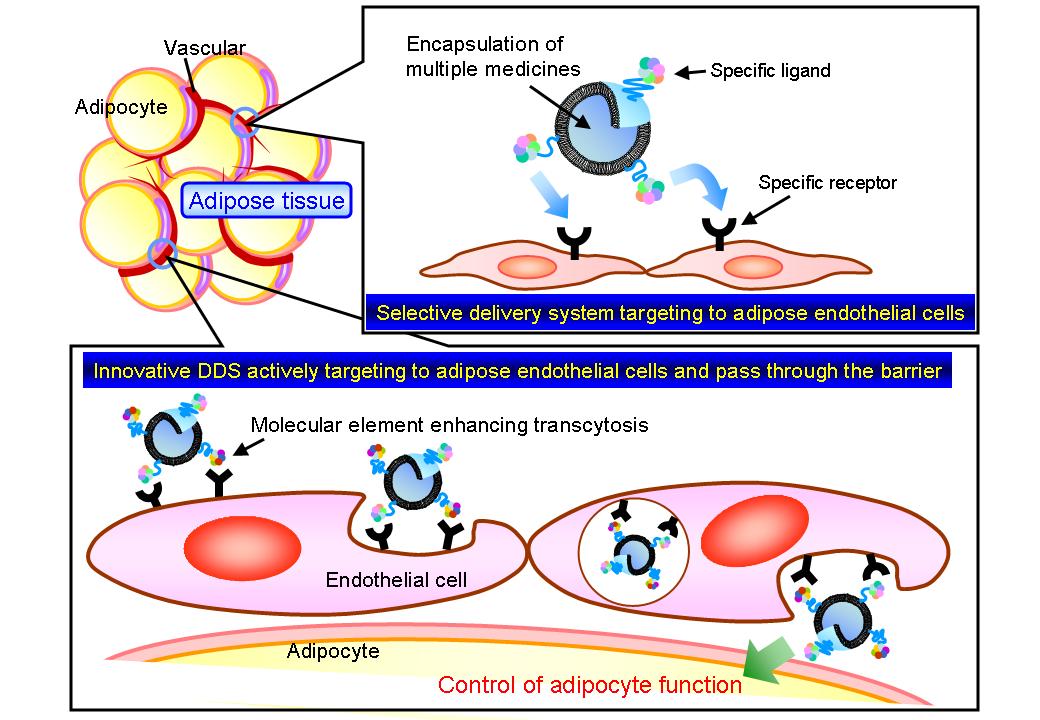
Our major research themes are described below;
- Development of a prototype delivery system using a peptide which has high affinity for adipose endothelial cells as a ligand
- Identification of novel target molecules specifically expressed in adipose endothelial cells based on a comprehensive analysis of gene expression
- Establishment of an effective technique for transfection of functional nucleic acid such as plasmid DNA, siRNA or miRNA to adipocytes
